|
Remember the Old Fanning Mill?
by
Very much a part of a museum collection these days seems to be the fanning
mill. They were as much a part of the farm of the old days as the old
oaken bucket. At least a few years ago, it could be found sitting forlornly
in back of the barn, long since forgotten by the present generation. When
I lived on a farm in the 1950s, we also had one stored in back of the
granary, with seemingly 50 years of dust on it. I used to like to crank
it, and always wondered what it was used for. I was told, "Oh, that's
just an old thing we used to separate grain."
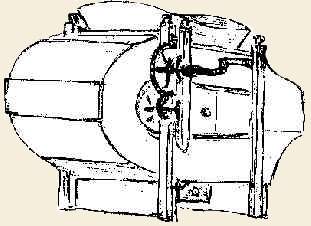
A fanning mill is a peculiar-looking device made of wood, with a metal
crank and wooden hand grip, and with sliding drawers, rounded board edges,
shaped carrying handles, and sometimes lathe-turned knobs atop the frame
posts, appearing almost like a piece of furniture. Like other old-time
machinery, fanning mills were attractively painted in gaudy colors which,
by this time, have long since faded away. But when restored to their natural
beauty, they are quite attractive.
Fanning mills removed straw, chaff, stones, dirt and dust, weed seeds,
and light immature seeds from wheat, oats, rye, barley, and other grains.
It was important to remove contaminants for better preservation during
storage, to have mold and grit free flour, and for securing viable seed
free of weed seeds that would compete with a growing cereal crop. Fanning
mills were a great technical advance over winnowing, the hand-process
of pouring grain from one container to another in a breeze to blow away
the lighter matter.
In many ways, a fanning mill resembles a miniature threshing machine.
Both machines have shaking sieves over which the threshed grain kernels
mixed with bits of straw, chaff, stones and soil particles rattle. The
smaller pieces fall through holes to a lower sieve where smaller particles
are separated. Both machines have fans that move air across and upward
through the sieves to float off the light straw, chaff and dust. Only
the threshing machine has a mechanism for knocking the grain kernels free
of their attachment to the grain stalk.
Before the introduction of threshing machines, grain was removed from
the stalk heads by trampling or flailing. This operation was done usually
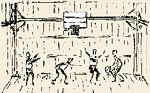
on a wooden floor in a barn. Threshing barns were built for the purpose
of storing grain sheaves from harvest time until the slack winter season
when the fully mature grain could be separated from the dry straw. These
barns were built around a central threshing floor where the bundles of
ripened grain could be spread to a uniform thickness and treaded upon
by hooves of horses or oxen or pounded by farm hands using wooden flails
to loosen grain kernels from heads of the cereal plant stalks.
When most of the kernels had been loosened from the grain heads, the
straw was lifted off with forks and stored for use as bedding for livestock.
The remaining material on the threshing floor was scooped up to be winnowed
when there was a breeze. Threshing barns usually had wide doors which
could be opened at either end of the center section to allow a favorable
wind to waft through the building. The chaff, bits of straw and the loose
grain from the threshing floor were put in a winnowing basket or tray
and tossed upward into a breeze where currents of air carried the straw
pieces, lighter chaff and dust farther away, as the heavier kernels of
grain fell more directly downward into a basket or onto a blanket.
Flailing and winnowing are strenuous tasks. It has been estimated that,
using a flail, one person could separate only seven bushels of grain per
day. Separating kernels of grain from chaff and stalks was a labor-intensive
manual procedure, and careful attention was required to extract the maximum
amount of good grain from the material left on the threshing floor after
flailing and trampling. To ease the arduous work and relieve the monotony,
threshing became a shared neighborly work project and a social activity
that continued on when farmers went from farm to farm with their wagons
to help each other gather shocks to feed into a threshing machine. Commonly
called "a separator" and mounted on wheels, it was moved from farm to
farm. All the cooperating farmers in a circuit made up a "threshing ring."
A fanning mill did a much more efficient job than winnowing, and it cleaned
grain more thoroughly than a threshing machine. Mills were kept around
farms for a long time to reclean oats and wheat in the spring for planting.
|