|
Sarah Lyon Davenport
The Grand Old Lady of Steuben County
by
On November 11, 1896, at 3 o'clock in the afternoon, in Bath, New York,
the Steuben County Legislature convened its regular meeting. One of the
items on the agenda was a report of a Mr. Bunnell "of the special committee
on the enlargement of the jail." According to The Advocate's account of
the meeting, Mr. Bunnell reported, "Your committee[,] appointed to meet
with Mrs. John Davenport, a member of the State Commission of Prisons,
in regard to crowded and unsanitary condition of our county jail, report
as follows: The committee have made a very thorough and pain-staking investigation,
considering the limited time assigned them, in visiting and conferring
with Mrs. Davenport, examining the jail, questioning the sheriff and carefully
going over the latter's report of the prisoners consigned to his keeping
during the past year."
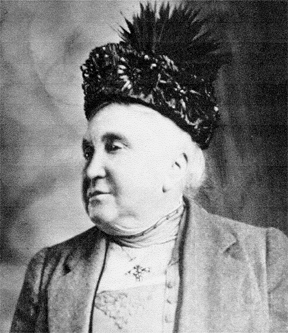
Sarah Lyon Davenport
Mr. Bunnell went on to explain that the State Commission of Prisons had
the right "to visit and inspect all institutions used for the detention
of sane adults charged with or convicted of crime, or detained as witnesses
of debtors; to aid in securing the just, humane and economic administrations
of such institutions,"…. After Mr. Bunnell lists the wide-ranging powers
of the State Prison Commission, he adds, in a slightly aggrieved tone,
"It will thus be seen that this commission is fully and legally authorized
to order any change of system, incur any expense or adopt any measure
it deems necessary or advisory, and the taxpayers must meet the expenses
attached to such procedure. Even the Board of Supervisors, heretofore
considered as possessing all powers necessary to enact laws for the proper
and reasonable governance of the citizens of this State, are powerless
to stay the hand of this newly enacted law and must needs execute such
orders and instructions the commission members may from time to time command."
Mrs. Davenport had informed the Legislature that the jail could not pass
an inspection by the Prison Commission, and had, as Mr. Bunnell phrased
it, "very kindly and considerately deferred the official visit of the
entire Board to Steuben County until after this session of our honorable
body, in order that a committee by appointed, as has already been done,
to confer with her and learn what the demands of the said commission are."
Mrs. Davenport knew just what needed to be done, and her recommendations
show a knowledge and familiarity with the jail. "She informs us that the
urgent, compulsory needs of the Steuben County jail are for increased
cell room, a hospital room, and a bath room. There are at present 55 prisoners
in the custody of the Sheriff, with but 30 cots for their sleeping accommodations,
(except as he improvises cots on the floor) and the bath room luxuries
are supplied through the medium of a common wash tub."
The legislators tried putting forth some suggestions such as "annulling
the agreement with the village of Bath," and by "compelling, if found
lawful[,] the recorders of the two cities in this county, and the village
police justices to send more convicted persons to the Monroe County Penitentiary,"
but Mrs. Davenport "firmly informed us that such a course would not satisfy
the Commission." Then Mr. Bunnell adds, "Every possible means was resorted
to for the purpose of dissuading her from her position, but all to no
purpose, and your committee would therefore urge the necessity of some
speedy action."
It could be that Mrs. Davenport's firm position was influenced by her
knowledge of the long-term complaints of the jail. Twelve years before,
the Courier had printed an article headlined: "The County Jail,
Considered by the Supervisors, Its Management Severely Attacked by the
Bath Board of Health." At 11 a.m. of a November day, the Board of Health
had found the temperature inside the jail to be 55 degrees downstairs,
and 57 upstairs, "which was altogether too low for health and comfort."
But there was worse to come. "They examined the beds, and found that the
clothing for each consisted of a thin straw tick, and one blanket, which
was not sufficient to keep the prisoners warm, who therefore had to sleep
with their clothes on. There were no sheets and no pillows. The floor
was damp and moisture trickled down the walls. It was the custom, he learned,
to flood the floors and let them dry. On inquiring of the turnkey, he
found that some of the prisoners were afflicted with rheumatism, coughs
and colds." But there was even worse.
"The jail both upstairs and down was filled with foul gases from the
vault, caused by imperfect ventilation, and the fact that the vault had
not been cleaned out since the jail was first occupied two years ago…"
But we need not dwell further on what the board of Health found. That
is enough to show that Mrs. Davenport along with other readers of the
Courier, must have known something about the running of the jail.
After all, Dr. Crittendon, a member of the Village Board of Health, had
said, "that persons passing on the opposite side of the street who noticed
the odors emanating from the jail, were the first to call the attention
of the Board of Health to the conditions of the building." Sarah Davenport
had reason to be "firm" with the county legislators.
Sarah Davenport, Mrs. John Davenport, had been appointed to the Prison
Commission by Governor Morton only in 1895, and had been on the commission
for only a year. But she was a mature 49 years old when she faced down
the legislators, and had been on the State Charities Aid Association since
1884. Still, it is hard to explain why Sarah Davenport gave her life to
helping others in such a public way. How can we explain the list of Sarah's
interests and energies? She was, of course, for many years, a Trustee
of the Davenport Home for Orphan Girls, her husband's family's project,
but she wanted to save the world from suffering wherever she saw it, even
beyond Bath, New York.
Besides her work until her death at 84 years, on the Prison Commission
and its follow-up, the State Department of Corrections, she was a member
of:
Steuben County Board of Child Welfare
State Charities Aid Association
National Association for the Study and Relief of Epilepsy
Commission for the Care of the Insane
Board of Visitors of the Willard State Hospital
American Prison Association
Bath Chapter, American Red Cross
Her interest in the history of her home town and of her state was very
much a part of her life, as well. She was an active member of:
Baron Steuben Chapter, Daughters of the American Revolution
National Society of the Daughters of Founders and Patriots
American Scenic and Historical Preservation Society
It was said of Mrs. Davenport in her obituary that "her benefactions
were many and generous among the needy close at hand and known only to
those to whom extended." And, "She gave liberally not only from her purse,
but from her heart." Where did Sarah get her desire and her confidence,
her moral authority to reach out to the bigger world?
It was not likely that she got it from her mother. Sarah's mother, Harriet
Robie Lyon, although a well-loved woman, was content with her home. Her
obituary says of her, "Her birth place was always her home, where she
founded all the attachments that grew with advancing years, and fulfilled
all the requirements of a useful life in the various relations of home,
family, church, and widespread friendships."
Historian Craig Braack says that the Civil War forced women out of the
home when it took men out of the communities. He says that women were
the only ones left to run the churches, schools, hospitals, and many other
civic projects. Sarah was 18 years old in 1865, mature enough to be influenced
by such a force, and if she was awakened to the ability of women to fill
men's shoes, she had plenty of examples in her male ancestors.
Sarah Elizabeth Lyon
Sarah Elizabeth Lyon was born February 19, 1847, into a wealthy Bath
family. Her ancestors had helped to develop Bath from its earliest days,
and had their fingers in many pies. Grandfathers Reuben Robie and Moses
Lyon bought and sold real estate around the area. Moses built the Presbyterian
Church, completed in 1825. Both Moses Lyon and Reuben Robie were elected
Village President for many terms, as was Sarah's father James Lyon, as
well as her husband, John Davenport. Reuben Robie helped to organize the
Bath Library as did Sarah's husband. Reuben was a Postmaster, a bank manager,
a successful merchant, a member of the Masonic Lodge.
Her great-grandfather Col. John Whiting had helped to organize the County
Agricultural Fair in Bath in 1819. Sarah's father, James Lyon, was General
Superintendent of the Steuben County Agricultural Society in 1867-68,
and her Grandfather Robie was elected to a Life membership in the Agricultural
Society in 1872. Sarah's family helped to run the village of Bath, and
the wider community, as well.
When we began researching Sarah Lyon Davenport, it was harder to ferret
out details of her personal life. She was born February 19, 1847, to James
Lyon and Harriet Robie Lyon. She was the oldest child, followed by brother
Reuben Robie Lyon, born in 1857, and sister, Harriet Lyon, born in 1861.
We do have pictures of the residences. A look at the houses Sarah and
her family lived in shows they were affluent members of the community.
They were some of the most substantial homes of the day. Grandfather Reuben
Robie's house is still standing, as is Sarah's "Eight Acres."
Her husband's family, the Davenports, was one of the first families of
Bath. Her father-in-law died before she and John were married, but John
and his brother, Ira, Jr., continued to run the lucrative family business
of lending money to farmers in the Midwest, and they continued to support
the Davenport Home for Girls started by their father.
Sarah married John Davenport in 1879, when she was 32 years old. Did
she then start on her life of good works with her appointment to the State
Charities Aid Association? We do not yet know.
She was a family-oriented woman, who had close ties to her sister, brother,
nieces and nephews, as wonderful family photos, given to us by her great-great-nephew
Charles Carey, attest. She and John lived with his younger brother Ira,
Jr., in the family mansion, Riverside, built by Ira, Sr.
When Sarah and John returned from their wedding trip of a world tour,
his brother gave them a lavish party at Riverside.
The following article appeared in the Steuben Advocate on August
4, 1880.
The evening of July 30th will long be remembered by guests
who were entertained by Senator Davenport. The party was given in honor
of the safe return from their wedding journey, a year's trip abroad, of
Mr. & Mrs. John Davenport. The thoughtfulness of our host exhibited itself
long before the grounds were reached, in having the streets sprinkled.
As we entered the grounds of Riverside, it seemed like a fairy land, so
bright was it with its many lanterns. The guests entered through a carpeted
tent, 40 by 60 feet, and were immediately shown into dressing rooms on
the first floor. After greeting our host and his friends, the floral decorations
attracted our attention particularly, the many yards of tastefully hung
smilax, interspersed with a pink flower of the cactus variety, which we
were informed was a native of Cape Hope; the mantels were completely filled
with rare flowers, one in the back parlor being exquisitely arranged,
the center was of a deep red flower with a "D" in white ones. Rustic baskets
of straw filled with beautiful flowers also met the eye.
Passing from the main hall to the piazza the same care for the
guests greeted everyone. At the left were tables with ice water and lemonade.
In front of the piazza a carpet was laid and seats for those who wished.
To the right, we passed from the piazza into an immense tent with its
smooth canvas floor which was thoroughly enjoyed by the dancers. Of the
music, it is only necessary to say it was Pappenburgh's Band of ten pieces.
The lady dancers had a pretty remembrance of the delightful evening in
the dancing programmes which were in the shape of a miniature fan with
pencil attached. The tent was decorated in red and blue. In the center
of the tent was draped our country's flag, partially shutting off the
supper room. As we passed through, what beauty and taste met us. To our
country eyes, the likes had never been seen, for no one household could
gather together the beautiful things for table garniture, which Teall
of Rochester, had brought. The silver epergne in the center at least four
feet high, with its flowers and smilax, the candelabras with their many
arms, with the colors of the peach, orange, banana, and clusters of light
and dark Hamburg grapes, beside the more substantial, and handsomely decorated
dishes, made a picture which will be long remembered. We can not leave
the supper room without speaking of the creams and ices, which came to
us in small oval baskets on lace paper in small moulds, as well as in
ordinary shapes, which once tasted will never be forgotten.
The guests were between three and four hundred, coming from
all parts of Western New York; therefore, we will not attempt giving the
names of strangers present, fearing some noted one escaped our attention.
Our hosts' family present were Mr. & Mrs. Joshua Waterman, Detroit; Mr.
& Mrs. Sherman Rogers, Miss Rogers & friend, Miss Rochester, Miss Lilly
Rogers, Mr. Robert Rogers & Miss Masten, Buffalo; Mr. & Mrs. J. Adsit,
Hornellsville; Mr. & Mrs. William Taylor, Canisteo; Hon. John Davis &
wife, Mrs. Champlin, Miss Champlin, and Mr. & Mrs. D. Bauder of Hammondsport.
The reporter was obviously impressed, and who would not be?
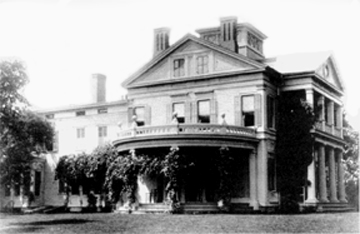
Riverside
Mrs. Davenport's home until her husband's death
After John's death, in 1895, Sarah moved from Riverside, and bought the
"Perine Castle," Number One, Haverling Street in Bath. She called it "Eight
Acres," and filled the eight acres with exotic trees and shrubs from all
over the world. From papers in the Kroch Library at Cornell University,
we learn that John's will left his share of Riverside to his brother,
Ira, Jr., but Sarah signed a document saying that she was "fully satisfied
and contented" with the provisions of her husband's will.
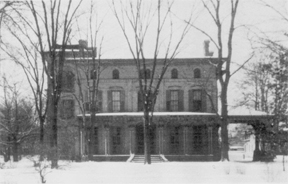
Eight Acres
Mrs. Davenport's residence from 1895 until 1929.
Photos from Charles Carey, great-great nephew of Sarah Davenport
She continued her work with the Prison Commission and other good works.
When a new governor was elected and made changes in the Prison Commission,
changing it to State Department of Corrections in 1907, Mrs. Davenport's
friends rallied 'round to make sure she continued her work. Dr. James
Folts, of the New York State Archives, has found a letter from the First
Director of the Women's Prison Association and Isaac T. Hopper Home, Sarah
H. Emerson, written to the Governor on May 29, 1907:
To the Governor.
Now that your signature has been affixed to the Bill providing
for an increased number of members of the State Prison Commission, we
wish to urge strongly the desirability of having at least one woman as
member of the board. A woman's eye is quicker than a man's to see defects
in the housekeeping of an institution. We have learned this in our visits
to the correctional institutions, where, for this very reason, our visits
are always welcomed.
Mrs. John. L. Davenport of Bath, N. Y. proved herself a most
valuable & energetic adjunct to the former commission. It was through
her unwearied efforts that the most important reforms in the Auburn State
Prison for Women were secured. Among them, the outdoor employment for
women prisoners which has proved so beneficial, morally & physically,
to the inmates. We wish very much that she may be named a member of the
new Commission. She is a woman of sterling qualities, long experience,
with time at command to devote to the service & we can hardly say too
much in her favor.
I am,
With great respect,
Yours very truly,
[Sarah H. Emerson]
First Director,
425 West End Avenue.
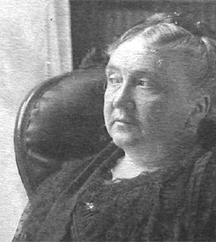
Mrs. John Davenport
A second letter, also found by Dr. Folts, is to Governor Hughes from
Mrs. Florence Kelly, the secretary of the National Consumers' League,
dated June 6, 1907. The letter asks for two women on the new prison commission,
"of whom we earnestly wish that one might be Mrs. Sarah L. Davenport of
Bath, NY. Her record speaks for itself."
Sarah Davenport continued to be appointed to the State Corrections Commission
until her death in 1929. Who knows how many times in those years she had
to take a firm stand with county legislators and other officials?
At the annual meeting of the prestigious Steuben Society, held February
15, 1929, at the Hotel Roosevelt [in New York City], member John S. Kennedy
rose to speak: "I desire to offer a resolution that a telegram of greeting
be sent by the secretary to Mrs. Sarah L. Davenport, the grand old lady
of Steuben County. Two years ago, Mrs. Davenport, was one of our honored
guests. She has expressed to me a great desire to be here this year but
is prevented by the state of her health. Her great interest in the society,
however, prompted her to send as her representatives her niece, Mrs. Rising,
and her husband, Captain Rising. Mrs. Davenport is, I believe, the first
woman ever appointed to public office and has for thirty years been a
member of the State Commission of Prisons, now the State Commission of
Correction. She has also been active in child welfare, the humane care
of the insane and the conduct of the Davenport Home, Bath, which has done
so much for orphan and neglected children." The Society sent to her
a greeting, expressing the hope for her quick return to good health and
activity and many long years of happiness and useful service.
When she died, seven months later, the Steuben Courier headlined,
"Her Activities and Influence Were State-wide, Her Home Was the Center
of Many Organization Functions While Her Health Permitted, Her Passing
Has Caused Universal Sorrow In Our Village."
The local chapter of the Red Cross adopted a testimonial to her after
her death. In 1917, when there was a call for the organization of a local
Red Cross chapter, Mrs. Davenport, although "unremittingly engaged in
other philanthropic causes…was ready with experience as well as good will."
She was a charter member and a "willing and material contributor from
year to year." She was a member of the executive committee "where her
attendance was never perfunctory, nor her keen judgment lacking."
Erwin Bowlby White, writing, forty years later, of her father James Lyon,
gives the names of son Reuben and of the two daughters, Sarah and Harriet.
He is able to list Reuben's accomplishments as a successful lawyer, but
he says off-handedly, that… "Information about the daughters is scant."
He knew nothing of Sarah Lyon Davenport and her achievements. It is time
we remembered Sarah Davenport again.
The Steuben County Historical Society has another reason to remember
Sarah Davenport. She purchased from her neighbors, the Read sisters, a
handsome Hepplewhite sideboard that has great historic interest for the
Village and Town of Bath. The sideboard had been brought to Bath in 1801
by Major Presley Thornton and his wife who became managers for Col. Charles
Williamson's Bath estate, "Springfield." Years later Mrs. Thornton sold
the sideboard to the Read family. Two maiden daughters sold the sideboard
in 1899 to Mrs. John Davenport. Sarah left the sideboard to her younger
sister Harriet, who in turn left it to her niece Harriet Lyon Rising,
daughter of their brother Reuben Robie Lyon. This Harriet left it to her
daughter Bettina, who returned it to Bath after 200 years by bequeathing
it to the Steuben County Historical Society. The sideboard is a tangible
evidence of Sarah Davenport's love of history and love of her family.
Charles Carey provided the photographs above.
Providers of information about the life of Sarah Lyon Davenport:
Charles Carey, great-great nephew of Sarah Davenport
Marion Springer, Steuben County Historian's Office
Dr. James Folts, New York State Archives
Dr. Joseph Paddock, Steuben County Historical Society
Nedra McElroy, Steuben County Historical Society
Dorothy BeGell, Steuben County Historical Society
The Fry Notebooks of newspaper clippings were the source of the 1884
article on the Steuben County jail and of the article on the party given
for Sarah and her husband John Davenport when they returned from their
around-the-world honeymoon in 1880.
|