
Spring-Summer 2007
|
|
|
| Home | Index | Museums | Blog | Authors | Site Map | About |
|
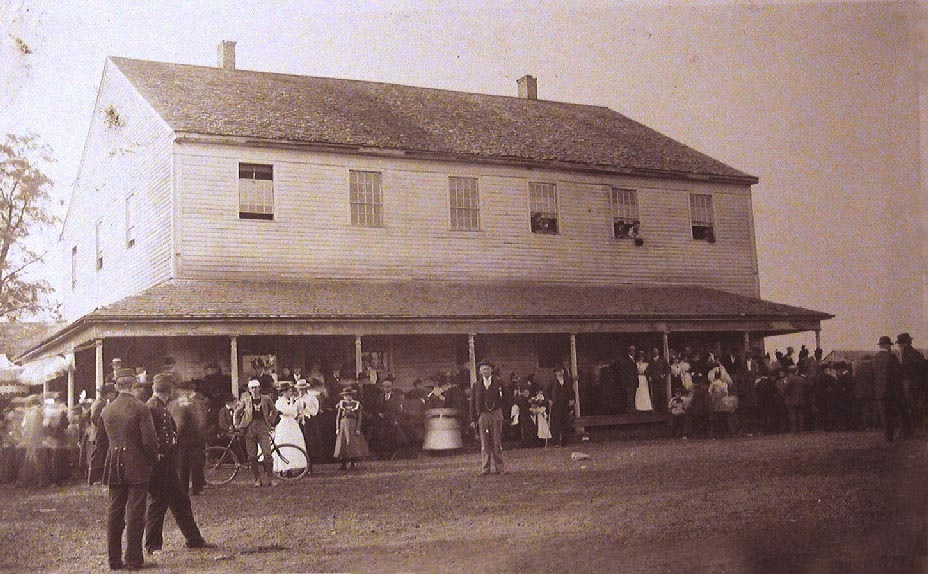
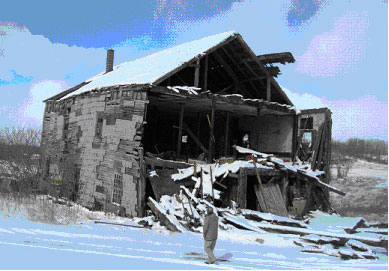
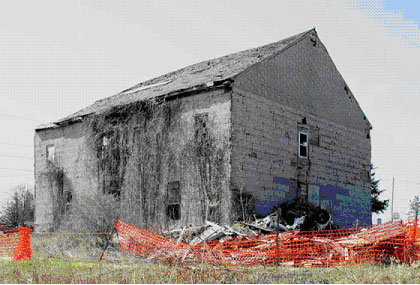
Farmington Quaker Meeting HouseBuilt in 1816byJudith Wellman and Stephen LewandowskiThe glacial cobbly soils and drumlin-hill-and-cedar-swamp landscape of northern Ontario County, New York have been wondrously productive of spiritual, religious and social movements. As a birthplace of spiritualism, millenarianism, and perfectionism and the pathway for numerous evangelical reforms and new religions, the Farmington area provides many notable examples of the movements that led western New York to be known as the “burned-over district.” The Farmington Quaker meetinghouse sits not only at a geographic crossroads but also at a crossroads of ideas. As the site of Farmington Quarterly Meeting, Genesee Yearly Meeting, and the organizational meeting of Congregational Friends, the Farmington Quaker meetinghouse binds together generations of Americans with roots all over the northeastern U.S., Canada, and Michigan. Carrying the legacy and the challenge of their Revolutionary fathers and mothers, Quakers who attended these meetings debated the essential meaning of the Declaration of Independence: “that all men are created equal, that they are endowed by their Creator with certain inalienable rights, that among these are life, liberty, and the pursuit of happiness.” American democracy founded on living documents finds a counterpart in the active spiritual search embodied in Friends meetings, where Quakers listen for and act on the “Inner Light’s divine requiring.” Longtime Farmington Quaker minister Sunderland Gardner states, “True religion comes not by tradition or creeds, but by obedience to the living word of God.” Because American democracy has remained open to such leadings, the universe of those experiencing fuller human rights has consistently grown, far beyond the small numbers of Quakers. Quakers and reformers affiliated with the Farmington meetinghouse influenced at least three major human rights reform movements in the nineteenth century, and their influence was so significant that it extends to the present day. First was their work with Native Americans. Seneca Indian land rights were especially important for Farmington Quakers. Following the tradition of their provision of teachers to the Seneca at Allegany and Cattaraugus and witness on behalf of the Haudenosaunee at the 1794 Treaty of Canandaigua, Seneca leaders and Quaker representatives from the Baltimore, New York, and Philadelphia Yearly Meetings of Friends met in the Farmington meetinghouse in June, 1838 to help the Seneca to retain ownership of their lands in western New York after the Ogden Land Company’s fraudulent Treaty of Buffalo Creek. To gain public support, the Quakers published the affecting testimony of Tonawanda Seneca leaders: “Brothers, we want the President to know that we are for peace, and that we ask only the possession of our rights. True, we are small in number, but we ask only for justice. We want to be allowed to live on our land in peace. We love Tonawanda. It is the residue of the land of our fathers. Here we wish to lay our bones in peace.” Quakers helped document the Land Company’s trickery and worked with Seneca people to influence congressional representatives and two Presidents to promote the compromise Treaty of 1842, by which Seneca kept their homelands at Cattaraugus and Allegany, avoiding another “Trail of Tears.” Though important to the Cattaraugus and Allegany bands of Seneca, the 1842 Treaty did not close the matter. Buffalo Creek reservation land was irrevocably lost. Well-meaning Quakers tried to induce Seneca men to cease hunting and follow the plow. They taught Seneca women to stop gardening and take up sewing. Quakers persuaded the Seneca at Cattaraugus and Allegany to drop their ancient mode of self-government where the clan mothers chose the leaders (royaner), in favor of elected chiefs. The Farmington Quakers also played an important role when the Tonawanda band of Seneca refused to change governments, leave their reservation, or conduct treaty negotiations. A delegation of Tonawanda clan mothers, including Minerva BlackSmith, Widow Little Beard, Susan BlackSmith, Jo-no-que-no, Gar-near-no-wih, O-no-do, De-wa-does, and Gar-e-was-ha-dus, petitioned President Tyler in 1842 to preserve their lands. Rochester Monthly Meeting member Amy Post worked with the clan mothers, solicited Quaker help, lobbied for Native American land rights and secured the traditional homelands of the Tonawanda band through a Treaty in 1857. Quakers were important in the early woman’s rights movement, far beyond what their numbers might suggest. Quakers had always been sympathetic to women’s rights, and Farmington Quarterly Meeting took the lead in promoting the rights of women both within Friends’ meetings and the larger world. In 1838, Quakers meeting in the Farmington meetinghouse abolished the distinctions between men’s and women’s meetings, the first Quakers anywhere to do so. In 1847, they participated in the antislavery Liberty League convention, at which women voted for the first time for presidential nominees and in which women for the first time received votes as presidential nominees (one vote each for Lucretia Mott and Lydia Maria Child). In 1848, Quakers meeting at the Farmington meetinghouse organized the Congregational Friends, in which men and women met together rather than separately, a practice later adopted by all Friends meetings. In 1848, Quakers from Farmington Quarterly Meeting helped organize the nation’s first woman’s rights convention at Seneca Falls, New York, and about one-quarter of the one-hundred signers of the Seneca Falls Declaration of Sentiments came from Farmington Quarterly Meeting. Though Elizabeth Cady Stanton is rightly given credit for organizing the Seneca Falls convention, she was inspired and helped by Quakers from Junius Monthly Meeting in Waterloo, part of the Farmington Yearly Meeting. There would have been no Seneca Falls woman’s rights convention without these Quakers. The Seneca Falls convention precipitated the organized woman’s rights movement nationally. Before Seneca Falls, there was no organized woman’s rights movement. After Seneca Falls, national newspapers took notice of the Declaration of Sentiments, and women and men began to generate petitions, hire lecturers, and organize conventions. The earliest conventions, beginning in Rochester in August 1848, were located in areas where Congregational Friends were strong. The first state convention in Salem, Ohio, was attended by many Congregational Friends. In 1850, the first national woman’s rights convention was held in Worcester, Massachusetts, with two members of Farmington Monthly Meeting, J.C. Hathaway and Pliny Sexton, attending. Hathaway was President pro tem. Nationally important woman’s rights leaders, including Lucretia Mott, Elizabeth Cady Stanton, and Susan B. Anthony, spoke in the Farmington meetinghouse. All three of these women (including Stanton, who considered herself a Congregational Friend) were Quakers. Farmington was also a key node in the abolitionist movement and the Underground Railroad. Austin Steward, who escaped from slavery in 1815 and lived in Farmington for four years, almost certainly helped build the 1816 meetinghouse. Frederick Douglass, William Lloyd Garrison, and other abolitionists spoke in the meetinghouse. Members of Farmington Monthly and Quarterly Meetings organized some of the earliest female and male antislavery organizations, antislavery fairs, and a free produce store. Key officers in the Western New York Anti-Slavery Society were members of Farmington Monthly and Quarterly Meetings, as were abolitionist lecturers and organizers of the anti-slavery political party, the Liberty League. From the 1810s to the Civil War, Farmington was also a center of Underground Railroad work. Beginning in the late 1840s, members of Farmington Quaker meetings worked with an Underground Railroad network that extended from Washington, D.C., maintained by William Chaplin. Key Quakers associated with the Underground Railroad in Farmington included Joseph C. and Esther Hathaway, Phebe Hathaway, Asa B. and Hannah Comstock Smith, William R. Smith, Esek and Maria E. Wilbur, and Cassandra Hamlin, Elias and Susan Doty, Griffith and Elizabeth Cooper, and Pliny Sexton. The M’Clintocks and Hunts in Waterloo, New York, were part of Farmington Quarterly Meeting, and their homes are documented Underground Railroad sites. (The M’Clintock and Hunt houses are both listed on the National Register and National Park Service’s Underground Railroad Network to Freedom. The 1816 Farmington Quaker Meetinghouse is also listed on the Network to Freedom.) Amy and Isaac Post, the Anthony, DeGarmo, and Fish families worked on abolitionism, woman’s rights, and the Underground Railroad with Frederick Douglass in Rochester. The African Americans associated with abolitionism in Farmington, included freedom seeker Austin Steward, William Wells Brown and his daughter Josephine, Mary and Emily Edmondson, and Charles Remond. European-American abolitionists included William Lloyd Garrison, William Chaplin, Myrtilla Miner, and Gerrit Smith. Struggling over issues of slavery and freedom, Quakers and their reform allies in Farmington tried to balance individual rights and community stability. They never disagreed about the basic value of absolute human equality, but they did disagree on how they should work toward implementing equality. The question revolved around agitation. Toward the end of his life, Frederick Douglass advised, “Agitate! Agitate!! Agitate!!!” Jacob Ferris, a member of Farmington Quarterly Meeting, agreed: “It is to me, absurd that, at this day and age, Friends should talk about keeping to the quiet . . . . agitation has been productive of great good to the world.” But Sunderland P. Gardner, Farmington minister to the quietist branch of Hicksite Friends, disagreed. “Wrong may be wrongfully opposed, and war may be opposed in a warlike spirit.” Disagreement over agitation produced a “moral earthquake,” within Friends’ meetings and in reform movements, especially abolitionism, as a whole. Farmington Friends were at the cutting edge of this debate. Architecturally, the Farmington meetinghouse represents an early style of Quaker worship: a two-cell meetinghouse plan appropriate for separate meetings of ministers and elders and separate meetings for men and women. The building incorporates the simplicity, integrity, and sense of community inherent in the Quaker worship and values from the seventeenth century to the present. |
 |
 |