|
Grandma's Barn
by
I confess that along with wanting to hear Grandma's stories, I was drawn
to her home in Campbell, New York, by a strong desire to explore her barn.
As a horse-and-hay barn, it had been an occupational necessity for the
mail carrier who first owned the property in the late nineteenth century.
Above the main entrance was an opening that allowed hay to be loaded into
the loft. From there it could be dropped, as needed, down a chute and
into the stable. The rest of the ground floor provided room for at least
two carriages.
By the time of my earliest boyhood visits, the hay, horses, and carriages
were long gone. Instead, the barn was a catch-all storage area with almost
no open space left. On the ground floor were two Model-A automobiles and
various pieces of bulky, heavy furniture. Smaller, lighter pieces were
upstairs. And everywhere one looked—upstairs and down—were
boxes and loose items.
The barn wasn't heated or air-conditioned, and the only light was what
the windows let in. Objects stood in no particular order, and everything
was covered with dust—so that in later years, when I started taking
flash pictures, the upper surfaces of the wooden furniture all came out
looking like they had white marble tops.
I now realize that the barn must have been filling up for years—probably
going back well before World War II. But the accumulation also increased
literally overnight, on 2-3 December 1954, when Grandma's house suffered
a major fire while she was out of town (teaching at Newark Valley).
With so many interesting and unexpected things to be found—under
conditions of minimal adult supervision—the barn offered a great
place for a boy to explore. Thus one of my first questions after arriving
with my family would be: "Grandma, may I go out to the barn now?"
From time to time, things would turn up that I'd ask to keep. One of
these was Dad's erector set. I had first seen what could be built with
such sets when we visited a family in Texas with boys a little older than
I. So in the late 1950s when my parents wanted to reward me and my brother
Don for stopping our thumb sucking—by picking out anything we wanted
from the Sears catalog—Don chose a Cape Canaveral rocket set and
I chose an erector set.
By then we were living in Oklahoma, and while he was visiting us, Uncle
Bill (William M. Crosby)—my mom's younger brother—took my
picture.
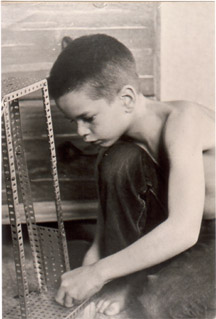
In background is my Ranch Oak dresser. It was part of a set that also
included a bed, desk, and bookshelves and that I had helped pick out when
we moved from our rented house near the university to a new house on the
edge of town.
Although clothes may make the man, the same can't be said for the boy
in the photo—for all he has on are his jeans. Even so, his bare
foot and bare back aren't central. More important are his hands, which
are actively at work on the erector-set structure. In the end, however,
the photo is a portrait and focuses on the boy's head.
His hair is closely cut—by his dad—and he holds his chin
quite near a sharply bent knee. His buck teeth are barely covered by lips
that neither smile nor scowl. Instead, they express the same absorbed
concentration as his eyes—which are aimed straight toward his hands
and his work. Far firmer than Ranch Oak, firmer even than erector-set
steel, is the hand-eye coordination of the engineer's son.
I had long enjoyed building with blocks, tinker toys, and lincoln logs.
Now I had a new and more challenging medium to play with. In addition,
I was able to make structures like those Dad had made when he was my age.
That illustrates the kind of power possessed by the things in Grandma's
barn. Although often limited and fragmentary in themselves, they provided
kernels for generating (or, at least, reinforcing) larger meanings and
grander activities.
By the time I moved to Rochester in the early 1980s, my interests had
shifted to building with words rather than material components. On my
Campbell visits, however, I continued to be fascinated by what I found
in the barn. For example, there was Grandma's Brownie camera, which she
had used to take many of the pictures she was showing me. I also expressed
interest in what she referred to as her "library table"—a sturdy
oak table, with a single drawer in the center and a shelf at either end—which
I now use for my computer desk.
Perhaps the most notable barn discovery during these later visits were
the Civil War letters written by Grandma's husband's father, Samuel Johnson
Cornell. I had long known about the letter that Uncle John has, the one
describing how my great grandfather's unit—the 107th New York Infantry—came
onto the Antietam battlefield just after the fighting was over. But I
hadn't expected additional letters to turn up—much less to turn
up in the barn.
Grandma agreed to let me take the letters back to Rochester for transcription.
Although I made good progress, the project took longer than I first anticipated.
When I found the letters, they were bundled together in a laundry box
upstairs. But because their envelopes were missing, their folds were exposed—so
that some had been charred in the house fire, while others bore the chew
marks of rodents.
An additional challenge was following the lines of writing around the
margins and even diagonally, over other parts of the letter. Finally,
there was the sheer volume of the collection—110 letters in all
(not counting Uncle John's). They began on 13 August 1862, when the 107th
left Elmira, and they ended on 7 September 1864, just before Johnson's
wife Kitty came to live with him. After mid-June 1863, however, my great
grandfather was no longer with the 107th. He had become ill, and after
convalescing he spent the rest of the war with the Veteran Reserve Corps
in Washington.
During the summer following Grandma's death, I "apartment sat" for a
friend in Silver Spring, Maryland. I was there primarily to pursue a research
project. But for recreation I tried finding traces of the city from the
time that my great grandfather lived there. At the Library of Congress
I located an illustration of the hospital where he worked. At the public
library I located an advertisement for the play he had attended at Ford's
Theater (Virginius, by Sheridan Knowles). And on day trips I
too enjoyed the views from Meridian Hill and Arlington Heights.
Thus I again experienced the protean character of the things in the barn—-this
time seeing their larger meaning through my own research efforts. While
Grandma was living, however, it was her stories that made the artifacts
come to life.
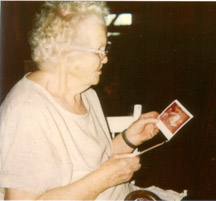
During my visits with Grandma after moving to Rochester, I deliberately
sought to link the chaotic assortment of the things in the barn with her
ability to tell stories. For example, in June 1987—at a time of
the year when daytime temperatures were still mild—I proposed that
we go to the barn together. She wore a house dress suitable for dusty
work. But instead of having her do the rummaging around, I used my Polaroid
Spectra—and brought the objects back to her, for comment, in the
form of pictures:
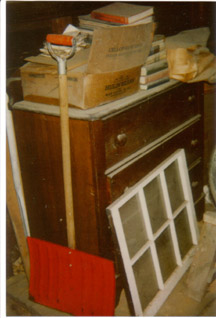
One of the things she talked about was the dresser near the foot of the
stairs. In the house, it had stood in the dining room, and her boys had
used it for their clothes. The highest drawer was Ed's, Grandma told me;
the next, Dad's; then John's.
Her mom had bought the dresser at the auction (which Grandma called a
"vendue") that was held just before her mom's sister Jane and Jane's husband
David Feagles moved west. In her parents' farmhouse on the hill, it stood
in the bedroom from whose window she had seen Halley's comet as a girl.
When her parents moved to Campbell (to a house on Main Street), the dresser
was put upstairs, in the bedroom over the kitchen. Grandma didn't mention
when it had come to her house on Center Street, but she did tell me she
wasn't happy with it after it went through the house fire—which
was why she had left it in the barn.
Also on the first floor of the barn was a small cabinet, painted blue,
with three shelves. Grandma recalled playing with it when she was growing
up, but it had originally been made for Uncle Luther—her mother's
oldest brother—when he went to Sonora Academy (in Sonora, New York).
Early in the Civil War, Luther's father paid a bounty so that his son
could stay on the farm. While visiting relatives in Michigan, however,
Luther joined the 11th Michigan Infantry—and after the war he moved
to Kansas.
Upstairs in the barn was Grandma's mother's dining room extension table.
"She was proud as Lucifer of that table," Grandma commented. Nearby was
the four-burner kerosene stove from her mother's kitchen in town. "She
cooked my wedding dinner on that stove," Grandma told me. "She cooked
two cakes, one on Sunday and the second—a coconut layer cake—on
Monday morning before the wedding. Father was in a jolly mood that day."
The barn also held things from her husband's side of the family. "Some
of the furniture was Grandma Dean's," she said—then added: "The
first year George and I were married, we went to the cemetery at Coopers
Plains on Memorial Day. Samuel Johnson Cornell and his wife Catherine
Dean Cornell are buried there. So is Grandma Dean (Kitty's mother). There
is no marker for her, but there is for her husband, Freeman Dean—a
small marker at the base of a large evergreen tree."
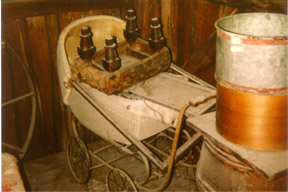
Because Grandma had been showing me photos of Ed, Dad, and John as babies,
I was especially interested in the baby buggy in a corner upstairs:
Upstairs as well was the crib that appears in the the baby photos. At
first it had been mounted on rockers. But, Grandma explained, "Mr. Look
[a neighbor across the street] took off the rockers and put on wheels
in their place."
Stacked against the crib were three large, framed photographic portraits.
One showed Ray Cornell—a brother of Grandma's husband—who
had owned a store in Corning and who had died of tuberculosis. Another
showed a baby that she identified as Sam, the son of her husband's eldest
brother Ed and his wife Frances.
But Grandma had the most to say about the third portrait—because
it showed her as a girl. In it she was wearing a bright red wool winter
dress, and she told me she could remember putting her fingers through
its wide, cream-colored lace trim. She also described how her mother had
curled her hair—by winding it, wet, onto heavy rags.

The photograph was taken in Elmira, where Grandma had gone with her mother
to visit her mother's cousin, Charles Emerson, and his wife Lois. Starting
in Campbell, they traveled to Corning via the Rochester branch of the
Erie and then took the Erie mainline the rest of the way. The occasion
was a family funeral, and Grandma remembered the long ride to the cemetery
in a horse-drawn cab.
During this same visit, they were persuaded by their relatives to go
to a photographer, and Grandma recalled that he took several shots. For
some she was asked to stand on the wicker chair. Each time, however, she'd
let her feet slide across the velvet seat until she was seated again.
Also upstairs in the barn, that day in June 1987, Grandma and I came
across the drawer for her library table. The table itself was downstairs,
in the stable. But because the drawer was filled with photographs, it
had been put upstairs. Grandma agreed that we could take it back to the
house, and on subsequent visits that summer we enjoyed going through its
contents together—thus generating for me many more family stories.
After Grandma's death, I pulled the remaining papers and photos from
the barn. Everything else was distributed among family members, or otherwise
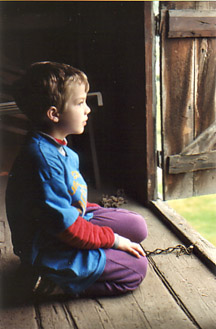
disposed of. By spring, when my brother Don came to visit and I took a
picture of his son Brian looking out the loft opening, the barn was basically
empty and "broom clean." But I'll always remember it as a magical place
that—along with Grandma's stories—gave me a powerful sense
of the past.
Illustrations supplied by the author
|