|
Exploring Cobblestone Country
by
It was Saturday, September 24, 2005. The crisp, clear autumn air had
not yet been warmed by the morning sunshine when members of the New Society
of the Genesee arrived in Childs, New York, site of one of the country's
most remarkable and unique concentrations of local architecture. At the
intersection of Routes 104 and 98 stand a cobblestone church, two homes
and a school house, part of the Cobblestone Society's efforts to preserve
examples of the highly unusual form of building construction.
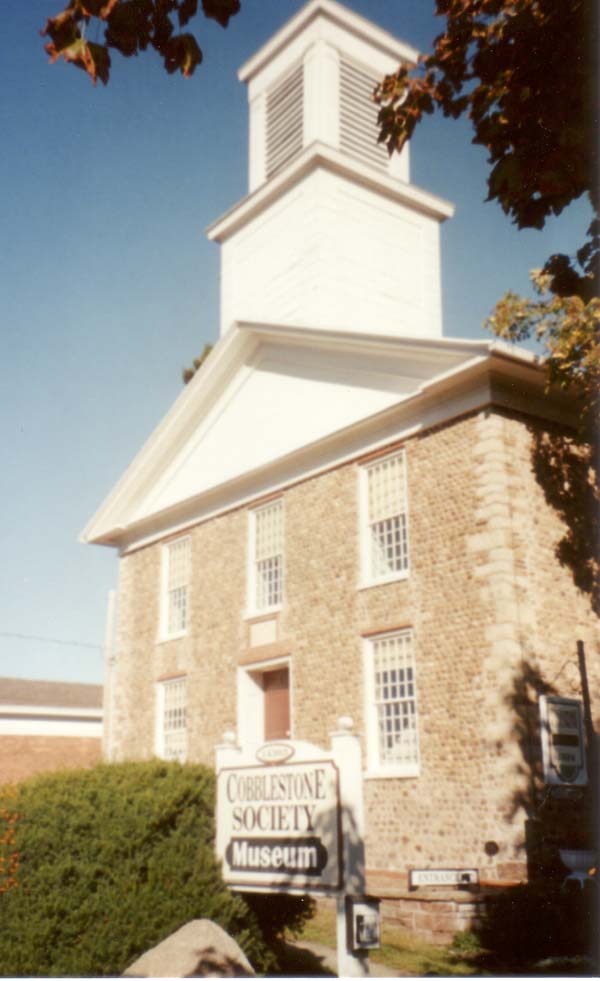
The Society, formed in 1960, had both foresighted and enthusiastic members
who saved seven rare buildings from inevitable destruction, perhaps to
be replaced by parking lots, gas stations or, heaven forbid, even a Wal-Mart.
Happily today the Society, led by Bill Lattin, Cobblestone Museum Director
and Orleans County Historian, can proudly host groups such as ours who
can appreciate the extensive restoration work that visually allows visitors
to return to a time in the rural past when these structures were built
by the prosperous owners.
As our group sat in 1894 vintage, spindle-backed chairs in the basement
of the First Universalist Church, Bill explained that of the 1200 cobblestone-faced
buildings in North America, ninety percent are located within 75 miles
of Rochester. We marveled at the extensive refurbishing given this room
which houses many of the museum's artifacts. Bill continued to relate
that between 1825 and 1860, 900 cobblestone structures where created by
masons using lake-rounded or "glaciated" cobbles. These are "stones that
could be easily held in one hand."
Such cobbles were sorted and sized through metal hoops called "beetle
rings" or by sorting boards, then taken from the lake shore by ox cart
to the building site where the cobbles were embedded into soft, lime mortar
layered onto the exterior face of a building wall. Four horizontal rows
were placed in an 8 inch band of mortar. Placing additional layers had
to wait until the mortar had hardened. Usually the cobblestone veneer
was backed with a thick wall, often composed with as much at twenty-four
inches of rough stone rubble providing a sturdy wall and creating unusually
deep window sills. Some buildings were faced with a herringbone patterns
using flat "skipping stones" from the lake shores. The skilled masons
received fifty cents for a day's pay.
We moved to the church's sanctuary and sat in the pews while Bill pointed
out the many unusual features of the Universalist church built in 1834.
In 1874 the interior was remodeled and trompe l'oeil paintings
were added including a back drop to the altar that appeared to be three-dimensional.
Bill contrasted the forms of religious services and interior appearances
of such early Protestant churches with the more elaborate rituals and
church interiors of Roman Catholic churches of the time.
From the church we went next door to the Ward House, a Federal-style
cottage once the church parsonage for John Proctor, both pastor and founder
of the hamlet of Childs. The restored interior is filled with period artifacts,
photos and furniture and has a kitchen complete with zinc sink, cast iron
stove and several ingenious and practical utensils.
Going east from the house, we entered the one-room cobblestone school
house built in 1849 as Bill tolled a quaint school bell which is as old
as the school itself. The wooden structure had an exterior façade
created of neatly mortared, lake-washed cobbles set off by corner quoins,
sills and lintels of red Medina sandstone. After squeezing into the early
school desks, we listened as Bill informed us of the school's history,
then directing our attention to the room's original furnishings on a sloping
floor and word puzzles on black-painted chalk boards. Above a line were
the letters U and R; below the line was the number 18. These were followed
by the letters U, R, A, Q, T even with the line. "You are over eighteen."
And, "You are a cutie."
Farther southwest, across Route 104, the Cobblestone Society has restored
four additional wooden buildings: a 1922 blacksmith shop with an overhead
belt system to power machines, an 1875 print shop with a printing press,
type cases and other printing equipment, a building built in 1838 for
a cobbler's shop and now holding materials once used by a harness maker
and shoe repairer, and the Farmer's Hall dating to 1855 which served as
the Old Kendall Town Hall and now contains early farm implements and tools.
At noon a tasty lunch was enjoyed by the 25 New Society of the Genesee
members present with Mr. Lattin as our guest. The meal was served by the
staff of nearby Tillman's Historic Village Inn at the intersection of
Routes 104 and 998. In the early 1800s the inn was a convenient stop for
stage coach patrons on their journey westward. Sparkling, animated and
informative conversations could be heard from all parts of the long line
of tables at which we were seated.
Luncheon was followed by a motor trip to the village of Albion to visit
one of the area's most historically significant buildings, the Pullman
Church. The church's patron was George Mortimer Pullman, inventor of Pullman
Sleeping and Palace Railroad Cars. His family settled in Albion in 1845.
Pullman had the $67,000 church built to honor his parents. Built in the
old English Gothic style on a cruciform plan, it was erected in 1893 and
1894, using red Medina sandstone. It replaced the Universalist Church
in Childs as the congregation's place of worship. Architect S. S. Berman
used 41 "drapery glass" windows manufactured by the Tiffany Glass Studios.
The largest window, designed by Tiffany craftsman Louis Frederick Wilson
weighs 1800 lbs. and is entitled "Christ the Counselor." Bill Lattin provided
fascinating facts and anecdotes about George Pullman and the building
of the sanctuary with its fabled Long and Low organ which has many of
its 1248 pipes stenciled with gold leaf.
The day concluded at 2:00 pm. It had been a fascinating adventure through
historic buildings with Bill Lattin, our most knowledgeable guide. Our
thanks also go to Richard Reisem and Gary Bogue for planning and making
reservations for the event.
— photograph by Richard Pierce
© 2005, Donovan A. Shilling
|